THE MELBOURNE CUP
First Tuesday in November · Flemington, Melbourne · One Day · Since 1861
2027: dates to follow
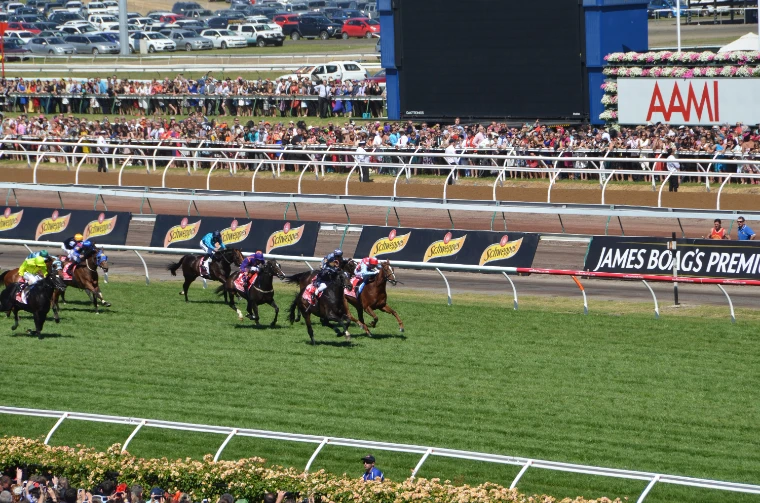
The Melbourne Cup is a horse race of 3,200 metres, once two miles, run at three o’clock on the first Tuesday of November at Flemington, beside the Maribyrnong River in Melbourne: a handicap for horses of three years and older, never more than twenty-four of them, on the Tuesday of a carnival of four racedays across eight. It is run by the Victoria Racing Club, and the city takes the day as a public holiday.
“The Melbourne Cup is the Australasian National Day,” Mark Twain wrote in 1897. “It would be difficult to overstate its importance.”
The First Cup
The Victoria Turf Club conceived it: a handicap over two miles, with a rich prize. Frederick Standish, a member of the club and a steward on the day, is credited with the idea and the name. The first Cup was run on Thursday 7 November 1861, by seventeen horses, for 710 gold sovereigns and a gold watch, hand-beaten, the winner to take all. About four thousand people came, fewer than hoped; the news of the deaths of Burke and Wills had reached the city.
Archer won it by six lengths. One horse bolted before the start, three fell, and two died. The legend has Archer walking the 800 kilometres from Nowra to the race; the newspapers of the day show that he came by steamer, on the City of Melbourne. He won again in 1862, by eight lengths, before seven thousand. In 1863 his acceptance came late by telegram and he was scratched; other owners withdrew their horses in sympathy, and seven ran, the smallest field there has been.
In March 1864 thirty-two gentlemen met at a hotel in Collins Street and merged the Turf Club with the Victoria Jockey Club as the Victoria Racing Club, which has run the Cup since its fourth running that year. It moved to a Tuesday in 1875, the first Tuesday of November, to fall on the public holiday for the Prince of Wales’s birthday. The next year the filly Briseis won the Derby, the Cup and the Oaks inside six days, ridden in the Cup by Peter St Albans, who was twelve, though he gave his age as thirteen. In 1890 thirty-nine ran, the largest field, and Carbine won under ten stone five pounds, the heaviest weight ever to win it.
Phar Lap won in 1930 at 8 to 11, the shortest-priced favourite in the race’s history, after he had been hidden at Geelong when a man tried to shoot him. The distance became 3,200 metres in 1972, a little shorter than the two miles. Vintage Crop, trained in Ireland by Dermot Weld, was the first winner from the northern hemisphere, in 1993. Makybe Diva won in 2003, 2004 and 2005, the only horse to win three times, and her trainer, Lee Freedman, said: “Go and find the youngest child on the course because that’s the only person here who will have a chance of seeing this happen again in their lifetime.” Bart Cummings, the Cups King, trained twelve winners. In 2015 Michelle Payne became the first woman to ride the winner, Prince of Penzance, at 100 to 1.
Flemington
The first race meeting on the flats beside the Maribyrnong was held on 3 March 1840, when Melbourne was “barely five years old”. The course takes its name not from the settler Robert Fleming, as is often said, but from James Watson’s property, which he named for his wife Elizabeth’s home town of Flemington, in Morayshire.
The course is pear-shaped, 2,312 metres round, and raced anticlockwise, with a straight of 1,200 metres known as the Straight Six. It holds more than a hundred and twenty thousand. The Cup’s own record is 122,736, in 2003. Since 7 November 2006 Flemington has been on the Australian National Heritage List.
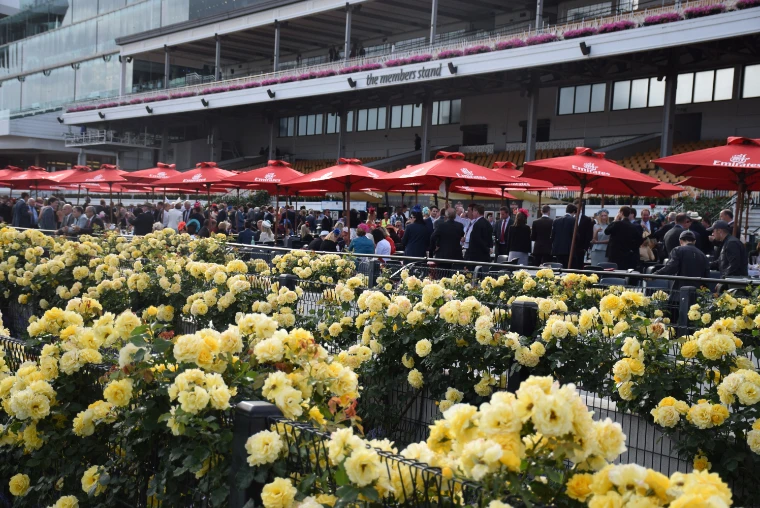
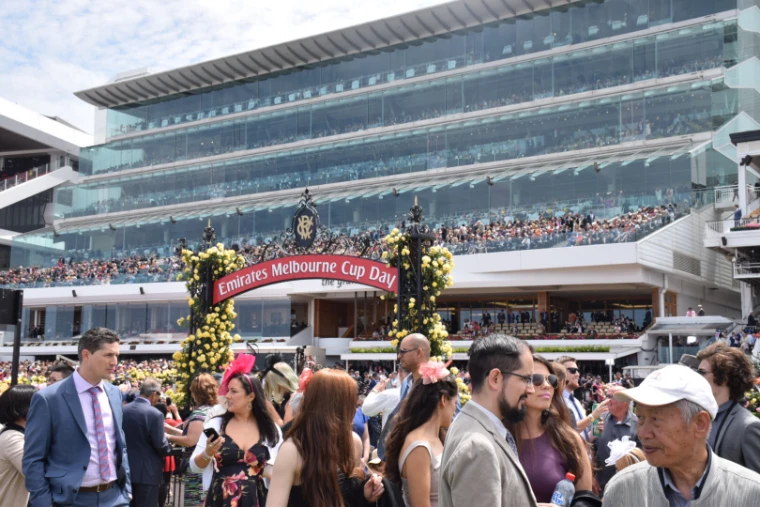
Henry Byron Moore, a keen gardener, oversaw the planting of its roses. There are some twelve thousand of them now, of more than two hundred varieties, and each day of the carnival has its flower: the cornflower for Derby Day, the yellow rose for Cup Day, the pink rose for Oaks Day and the red for Stakes Day.
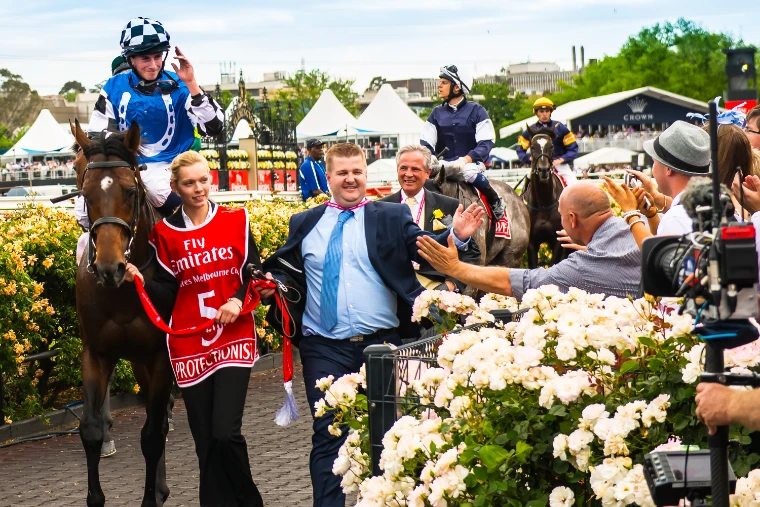
The first winner took a gold watch. The three-handled loving cup, designed by James Steeth, was first given in 1919. A new one is made each year, spun by hand from 1.65 kilograms of eighteen-carat gold, and a second is kept in case of a dead heat. The winning trainer and jockey have had a miniature since 1973, and the strapper is given the Tommy Woodcock Trophy, named for the man who looked after Phar Lap.
Cup Day
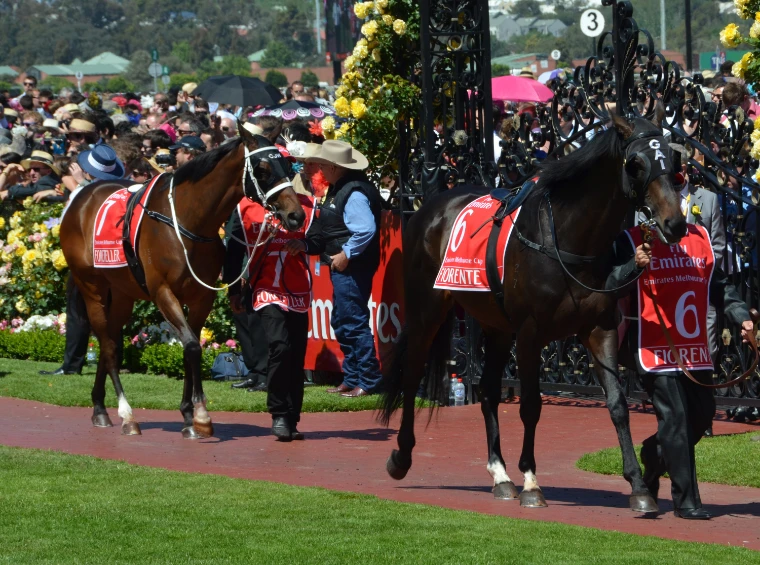
The carnival opens with Derby Day on a Saturday, holds the Cup on the Tuesday, Oaks Day on the Thursday and Stakes Day on the second Saturday. The Cup is one race on the Tuesday’s card.
Some three to four hundred horses are nominated. The Handicapper declares the weights in early September: a minimum of fifty kilograms, no maximum, and a top weight of at least fifty-seven. Under the club’s quality handicap the better horses are penalised less severely than a pure handicap would ask, but the better a horse’s record, the more it carries. Only twenty-four start, and the final acceptance costs A$45,375. The winners of certain races are spared the ballot, among them the Cox Plate, the Caulfield Cup, the Ebor and, from 2026, the Prix Kergorlay. Horses from abroad are quarantined at Werribee, thirty-two kilometres from the city. In 2025 the race was worth ten million Australian dollars.
The lawns have their own contest. Fashions on the Field was first held at Flemington in 1962, and the club calls it the world’s first. In 1965 Jean Shrimpton came on Derby Day in a white shift miniskirt, and the photographs went round the world. Each day keeps a register: Derby Day is black and white, and men are encouraged to wear a morning suit; Cup Day is for colour.
In 2025 Half Yours won the 165th Cup by two and three-quarter lengths for Tony and Calvin McEvoy, ridden by Jamie Melham, the first woman to win it since Payne, before 84,374.
The 2026 Cup is run on Tuesday 3 November, with Robbie Williams performing in the Mounting Yard before the race and again after the last.
What to Know
It is run on the first Tuesday in November, at three in the afternoon; in 2026, on 3 November. The 2027 date has not been announced. The carnival runs from the Saturday before to the Saturday after.
Tickets must be bought beforehand; there has been a limit on numbers since 2007. General admission on Cup Day is A$88, or A$128 with fifty dollars to spend on food and drink. The Members Enclosure, the Club Stand, the Grandstand, the Members Lawn and the Birdcage, nearly half the grounds, is for the club’s thirty thousand or so members and the guests they book. The club also sells marquees in the Birdcage, the Dress Circle over Fashions on the Field, and private suites.
In the Members Enclosure the rule is published: a suit, or tailored trousers with a sports coat or blazer, a collared shirt, a tie or bow tie, and dress shoes, and the tie stays on even with short sleeves. The public lawns have no rule. A lounge suit and tie; morning dress belongs to the Saturday, and Cup Day is the day for colour.
The train is the way: from Flinders Street, platform nine, by Southern Cross and North Melbourne, to Flemington Racecourse station at the gate. The No. 57 tram stops outside the main gate. Stay in the city, a few stops away. In 2025 the last train left the course at 8.59 in the evening.
The mistake is to come to the Members Enclosure without a tie. The club “reserves the right to deny entry or remove anyone deemed inappropriately dressed”, and the member who booked answers for the guest.
The Court
The Melbourne Cup is not the Court’s own. Places in the Members Enclosure, or a marquee in the Birdcage, are sought on a member’s behalf, and the Court arranges the whole of it: getting there, where to stay in Melbourne, and the table afterward.
How one becomes a member is set out under Admission.
Set down October MMXXVI