
THE BLACK TIE DINNER
Mid December · New York · An Evening · Hosted by the Court
2027: dates to follow
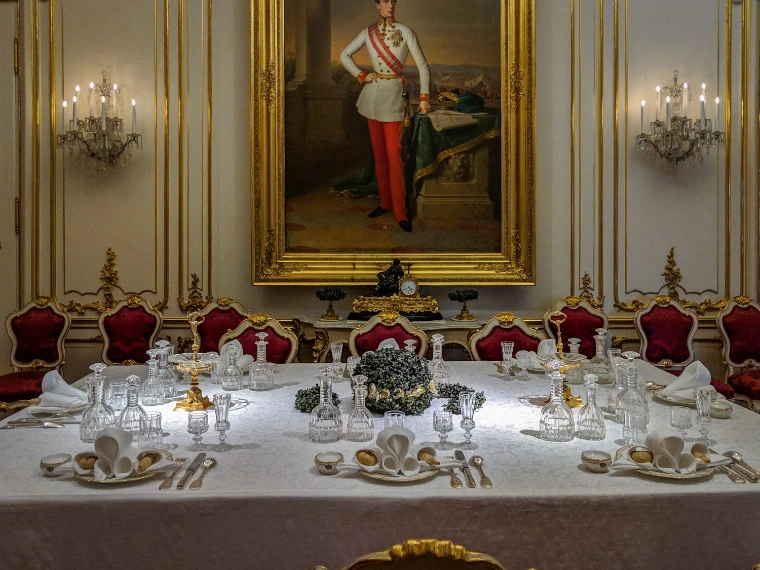
The Black Tie Dinner is a dinner in a private room in New York in the weeks before Christmas, taken for the night: black tie, one guest to a member, the seating drawn, the courses fixed, and the evening ending with port left on the table rather than a speech.
It exists because black tie began as the dress of an evening among friends, and the Court keeps one such evening before the year is out.
The Dinner Jacket
Black tie is “a half-dress Western dress code for evening events”: the dinner jacket, or dinner suit, in Britain, and the tuxedo in America. The earliest record of a tailless evening coat is a smoking jacket of midnight-blue silk, with matching trousers, which Henry Poole & Co. of Savile Row made in 1865 for the Prince of Wales, later Edward VII, to wear at Sandringham.
It began as a stand-in for the tailcoat at informal or stag evenings. It was “considered informal wear”, and the etiquette guides held it “inappropriate for wear in mixed company”. The Edwardians settled the black waistcoat and the black bow tie, and with them the line between black tie and white.
America took it from Tuxedo Park, “a Hudson Valley enclave for New York’s social elite”. In October 1886, at the first Autumn Ball there, Griswold Lorillard and his friends wore “a tailless dress coat”, and the word “tuxedo” was in use for it by about 1888. The story that James Brown Potter brought it from London “cannot be verified”. In 1909 Emily Post, herself of Tuxedo Park, wrote that its lapels “are to have facings of silk, satin or grosgrain.” Since 1918 it has been called “soup and fish”.
Its parts are fixed. The jacket is black or midnight-blue wool, single-breasted with one button, with peaked or shawl lapels faced in grosgrain or satin; a jacket without vents is the more formal. The trousers carry a single braid of silk or satin down the outer seam, have no turn-ups, and are worn with braces. A low-cut black waistcoat or a cummerbund goes over a white dress shirt, marcella or pleated, with double cuffs, a turndown collar, studs and cufflinks. The bow tie is black silk, matching the facings, and tied with “a common shoelace knot”. The socks are black silk or fine wool, and the shoes patent court shoes or polished Oxfords without broguing. The white dinner jacket belongs to warm climates; in twentieth-century Britain such jackets “were never worn” at home. Debrett’s adds one instruction: “avoid clip-on or ready-tied ties and learn how to tie your own.”
The Evening
One evening in mid-December, in a private room in New York taken for the night. The Court keeps no house of its own.
Black tie.
One guest to a member.
The seating is drawn.
The courses are fixed.
The evening ends with port left on the table, rather than a speech.
What Is Asked
Black tie: a black or midnight-blue dinner jacket with silk-faced lapels, trousers with a single braid, a white dress shirt with studs, and a black silk bow tie tied by hand.
A guest is twenty-one or older, and the member answers for them.
No speeches.
Nobody is pitched at the table.
The Places
The number of places and the sum are stated in the invitation.
The Court’s Investiture follows at the end of the month.
How one becomes a member is set out under Admission.
Set down October MMXXVI